
Many of you showed interest in this topic of why writers kill certain characters and I thank y’all so much that I made another post where we will dive even deeper into story structure, into what we call Kathersis, and a bonus example.
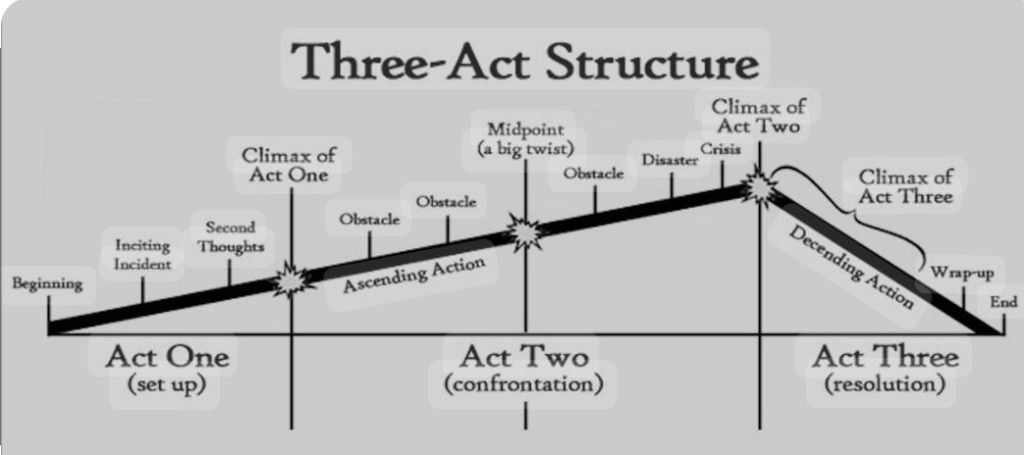
Here’s a story structure from StudioBinder’s article “What is the Three Act Story Structure–and Why it Works” by Alyssa Maio (https://www.studiobinder.com/blog/three-act-structure/):
Plots are simple (change without Reversal of the Situation or Recognition—a shallow story) or complex (change with Reversal of the Situation or Recognition—a chunky story). These things not only change the story but change the character. Also, sometimes a complex story will add even another layer called the Scene of Suffering. It is kind of self-explanatory. This part is when someone dies or gets hurt or something along those lines. Why? It brings in pity and fear.
A plot always imitates life—gathering a bunch of different sized actions to create a story that gets a message across to the character and audience. The plot often works hand in hand with the character because, well, that is who the story is about and because the character acts according to their qualities and beliefs.
Although every good story contains a beginning, middle, and end like the chart shown above, good stories also depend on what is expected from their genre. For instance, a romance differs from a tragic romance or a mystery differs from a fantasy. Consider that a tragedy genre uses death as good to bad, inflicting the audience with pity that something backfired. Now, consider a fantasy. Fantasy may use death as a bad to good, where death is the only way to stop a wicked witch.
In almost every story, death is used as an end, a stake, a risk. If death comes, there is no more story. It is used as fear and pity within a story.
When Death Happens
We know that death can be used to make a story complex. However, timing is everything. We storytellers think like this: What is the worst timing for the worst thing for my best character? Then, how do we want the audience to feel? How do the characters respond? Now, we got a whole bucket full of apples to work with.
Aristotle’s Katharsis is about how the audience feels. Katharsis is when you finish reading a book or watching a movie, you just sit in your chair for a moment. You and everyone else in the movie theatre are feeling mainly one emotion–shock, thrill, sorrow, gratitude, etc. You shut your book and whisper, “We got through it.”
That is a glimpse of Katharsis–the (usually awe) feeling after rolling through a story. So, pulling this together, when death happens in a story can be a form of Katharsis.
Bonus: Doc Hudsons’ Death Explained
Doc Hudson from Cars was a beloved character who died off-screen between Cars 1 and Cars 2. Now, a big reason for his death was probably because his voice actor sadly passed away. For the story of Cars, the storytellers used the heart of Doc Hudson to carry through the rest of movies. All this to say, when a character dies, it must take a toll and develop other characters because that is how real life is. As mentioned above, a plot imitates life.
Got Any Questions or Wanna See More?
I’d love to see your thoughts. Go ahead and shoot me a comment in the “Contact” section above!
 Michala Woodruff