
“Rodgers!” Snapping the spy glass shut, I turned to the voice sprinting up to me.
“We’re too far,” I began. “Anchor our lines to their bowsprit and heave in their head to our starboard. Shoot. Then haste to unlock and retreat.”
“There’s not enough manpower to maintain the cannons and pull a 1000-ton ship to us.”
“Then just wait for them to come.”
Tomas began shaking his head and then stopped at the sight of the British’s nearing direction. “Okay,” he gulped.
“I, uh, need a cannon. Also. Right there.” I pointed to the poop deck.
Tomas nodded. “I’ll get someone to make sure the sails are in position while I gather the men and tend to your cannon. One of us can check the wheel.”
I agreed as he disappeared into the impending fume.
When a different figure appeared.
This is one of the scenes from the first book in my series Captain She which I’ve been writing for the past several years. After a timeline of research, I found that I like exploring these ships. Even if I can’t literally tour them. However, I did tour the USS Olympia which I highly recommend seeing if you can; it was amazing! For now, let’s focus on the late 1700s to the early 1800s ships. The Revolutionary War is the beginning of our heritage in more ways than one. It’s when the US Navy began, amidst British waters. George Washington declared, “The value of liberty was thus enhanced in our estimation by the difficulty of its attainment, and the worth of characters appreciated by the trial of adversity.” Understanding these ships and who they carried can help us understand a new side of our freedom and help us put a new value on it. In the next several weeks, we’ll cover from top to bottom different decks, rooms, and jobs on a late 1700 ship. Welcome aboard!
Let’s start with different types of ships. The American Battlefield Trust explains that the first-rate ships would have over 800 officers and crewmen manning 100 guns throughout three decks while the next on the list are second-rate which would have 80-98 guns and third-rate which would have 64-80 guns but usually 74. These are called ships-of-the-line because they’d be the ones in formation like we see in movies. The American Battlefield Trust also points out that fourth-rate ships (50-60 guns) were considered ships-of-the-line until the American Revolution (pp 2) while fifth and six-rate ships (aka Frigates) were small, maneuverable, and perfect for escorts and raids. Lastly, unrated ships (vessels with 20 or less guns) were known as sloops, gunboats, cutters, brigs, and etc. In these tours, we’ll be hanging around the second- and third-rate ships.
Now, let’s talk sails. Philip K. Allen—writer of The Evolution of Sails in 18th century Warships for the U.S. Naval Institute—explained that sails were made from different grades of canvas with lighter material in the middle and heavier material at the sides (leech) (pp 2). Allen puts it well:
At the edges of a sail, the canvas was doubled over to increase its strength and then a bolt rope was stitched to the edge to prevent it from splitting. This rope was offset, so that even on the blackest night a sailor could distinguish front of sail from back by touch alone. The sail then needed to have various cringles (holes), clews (reinforced points for attaching lines at the lower corners), and reefing points (short lengths of rope for reducing sail) added. To make a single topsail for a ship-of-the-line has been estimated to have taken more than a thousand man-hours. (pp 3)
Sails have undergone a lot of changes, but the most important sail for maneuvering these 200-foot vessels was the sail at the head or front of the ship. Allen further points out that the farther froward the sail is, the faster the ship can turn (pp 6).
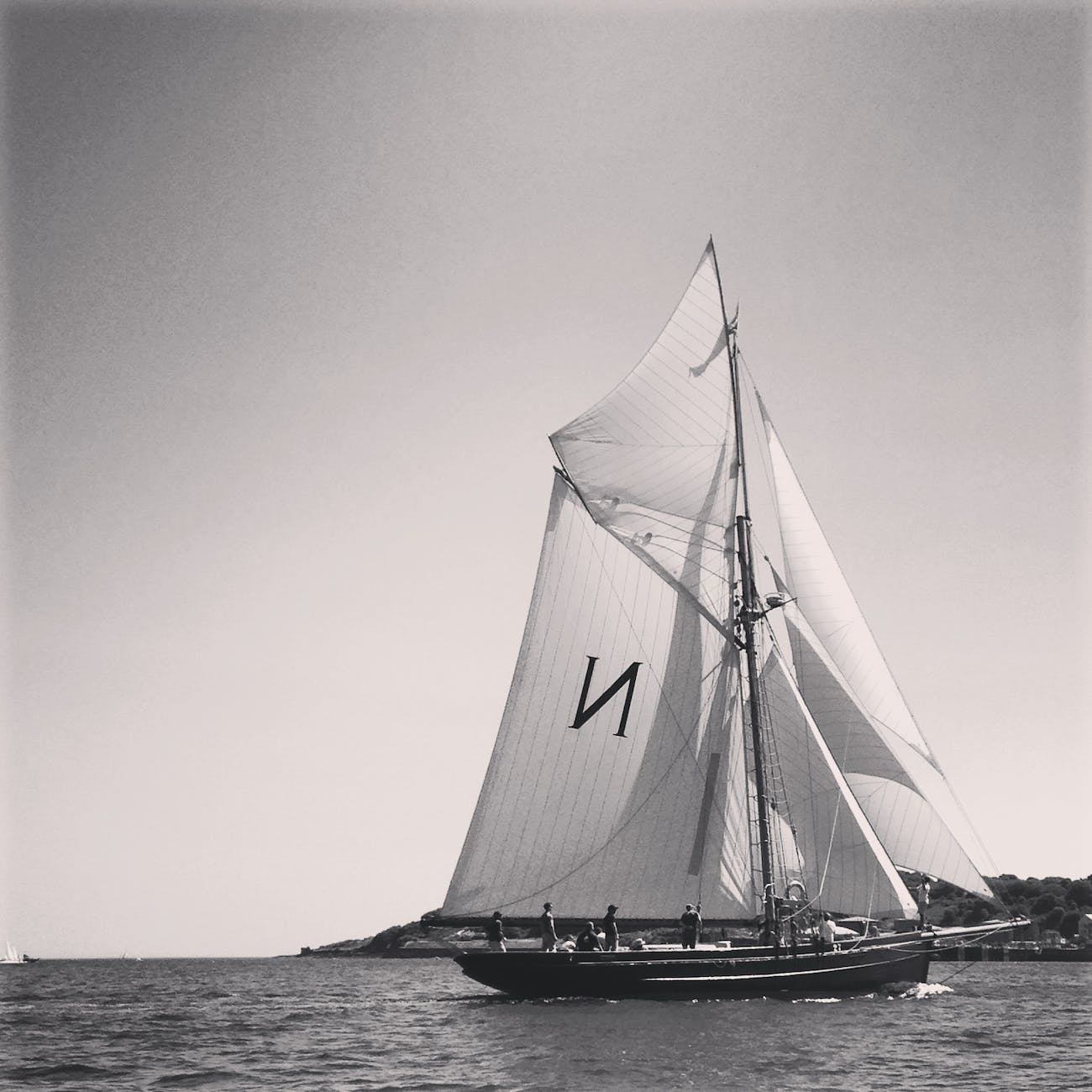
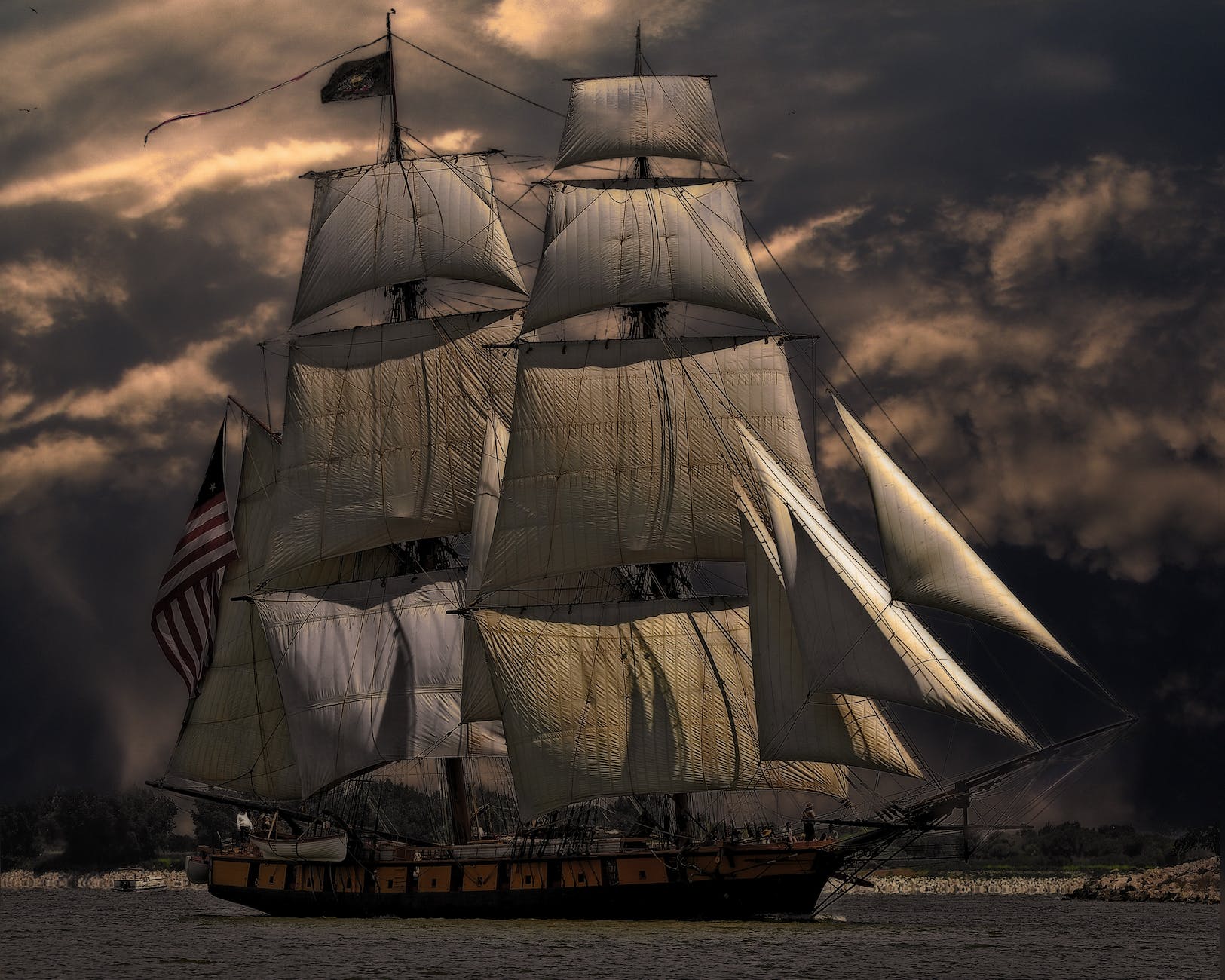
Finally, we have come to riggings: the fore and aft rig and the square rig. Fore and aft rigs are sails running along the ship’s plane like the picture to your left. According to Graham McBride—author of Sailing Ship Rigs for Maritime Museum of the Atlantic—, these sails are good for maneuvering (pp 4). On the other hand, McBride points out that square rigs—sails running across the ship from right (starboard) to left (port) like the picture to your right—are good for long voyages (pp 12).
This concludes our tour for this week. Stay alert for the next gander of a 1700s ship-of-the-line. If you have any questions, you’re more than welcome to shoot me an email in the contact section above or write a message in the “Leave a Reply” box below. Thank you!
Resources:
- https://www.battlefields.org/learn/articles/royal-navy-during-american-revolution#:~:text=Fifth%20and%20sixth-rate%20ships%2C%20known%20as%20frigates%20would,used%20for%20convoy%20escorts%2C%20reconnaissance%2C%20and%20commerce%20raiding.
- https://www.usni.org/magazines/naval-history-magazine/2022/february/evolution-sails-18th-century-warships
- https://maritimemuseum.novascotia.ca/research/sailing-ship-rigs
- https://www.britannica.com/technology/ship-of-the-line
 Michala Woodruff
Leave a reply to michalawoodruff Cancel reply